





Built-In Microwave Buying Guide- What to Know in 2026

A built-in microwave does something a countertop model never quite manages: it disappears into the kitchen. No cord trailing across the counter, no awkward gap between it and the cabinet above. The appliance becomes part of the wall or cabinetry, and the kitchen looks intentional rather than assembled piece by piece. That shift in how the space feels is usually what convinces people to make the switch.
But choosing the right model takes more than picking one that fits the hole in your cabinet. Wattage, capacity, cooking modes, and door style each affect how the appliance performs day to day.
What Makes A Built-In Microwave Different?
The installation is the core distinction. A built-in microwave oven fits directly into your kitchen cabinets or a fixed wall, creating a flush, seamless look that a countertop model sitting on a shelf cannot replicate. Many homeowners place it near the built-in oven so dishes can move between appliances without crossing the kitchen. That placement logic alone changes how the whole cooking area flows.
You also do not need a full kitchen remodel to install one. In most setups, a single section of existing cabinetry is modified or replaced to accommodate the unit. Built-in microwave installation is less disruptive than most people assume, and the payoff, a cleaner counter and a more cohesive kitchen, is immediate and lasting.
About The Size And Dimensions Of Custom-installed Microwave
|
24" |
Compact kitchens, limited cabinet space |
|
27" |
Mid-size, most common for households |
|
30" |
Family-sized meals, ample space |
This is where most buying mistakes happen. Built-in microwaves come in three standard widths, and selecting the wrong one means either a gap that needs a trim kit or a unit that simply does not fit. Measure the cabinet opening carefully before shopping, not after.
Depth matters just as much as width. Adequate ventilation requires roughly 15–22 inches of cabinet depth, depending on the model. A microwave installed without enough airflow behind it will overheat and fail early. This is a spec worth confirming before purchase, not after installation.
Door Styles Most People Realise
Aesthetics and usability are two areas that are impacted by the built-in microwave's door arrangement; there are three options to choose from. The swing-out door is opened like most common microwave ovens – from left to right. The drop-down door opens downwards, just like a regular oven, which is a well-known motion that people like when they want to put hot food into the drop-down. Then, there's the microwave drawer, which is in the lower cabinets and opens outward at counter height for easy access.
This drawer style is especially convenient for families, as there's no need to bend awkwardly or reach up and down, and the countertop is just right there to set the dish down when it's out of the oven. The drop-down door provides consistency in the kitchen wall. If the built-in oven is close by, this makes the wall look as if it were designed as one rather than a collection of appliances.
Features Worth Paying For: The Space-saving Microwave
- Timed Defrost: Enter item weight, and the microwave sets power and time automatically.
- Sensor Cooking: Humidity and temperature sensors adjust cook time for optimal results.
- Convection Cooking: Acts as a second oven, roasting, baking, and grilling beyond reheating.
- Broil Element: Finish dishes with browning or melted cheese directly in the microwave.
- Steam Cycle: Moisture sensors take the guesswork out of steaming vegetables and fish.
- Crisp Technology: Crisper pan lets you fry, grill, and brown food inside the microwave.
Built-In Vs Countertop Vs Over-The-Range
A countertop microwave plugs in and sits wherever there is space. Simple, portable, no installation needed. An over-the-range model mounts above the stove, doubling as a range hood, saving space but limiting placement options. A *built-in microwave oven* can go anywhere: at eye level above the built-in oven, inside an island, or below the counter as a drawer. That flexibility is the real advantage.
The trade-off is installation effort and cost. Trim kits can give a countertop model a semi-integrated look by closing the gaps around the unit, but the result never quite matches a purpose-built installation. If the kitchen is being renovated or designed from scratch, building in the microwave from the start is worth the investment. If it is a rental or a temporary setup, a countertop with a trim kit is the more practical choice.
Final Thoughts
A built-in microwave is one of those appliances where the decision really comes down to how long you plan to stay in the kitchen setup. For a permanent home or a renovation, it is genuinely worth building in; the counter space, the clean look, and the cooking capability all improve in one move.
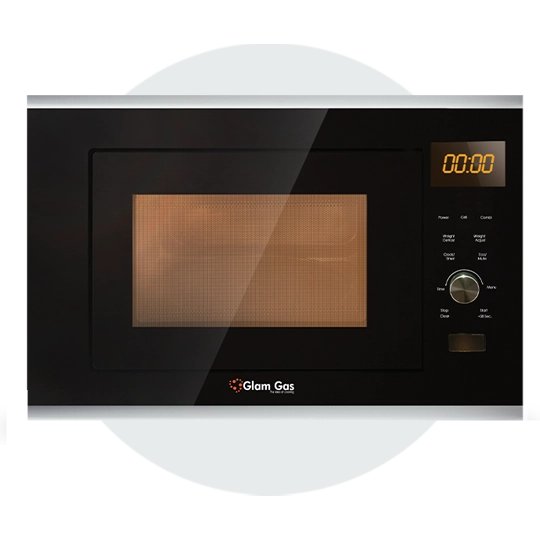
The Glam Gas built-in microwave range is designed specifically for modern Pakistani kitchens, compact enough for practical installation, capable enough for real daily cooking. Pair it with a built-in oven and built-in hobs for a complete, cohesive kitchen setup that actually looks like it was planned that way.


